Portal:Computer programming

The Computer Programming Portal

Computer programming is the process of performing a particular computation (or more generally, accomplishing a specific computing result), usually by designing/building an executable computer program. Programming involves tasks such as analysis, generating algorithms, profiling algorithms' accuracy and resource consumption, and the implementation of algorithms (usually in a chosen programming language, commonly referred to as coding). The source code of a program is written in one or more languages that are intelligible to programmers, rather than machine code, which is directly executed by the central processing unit. The purpose of programming is to find a sequence of instructions that will automate the performance of a task (which can be as complex as an operating system) on a computer, often for solving a given problem. Proficient programming thus usually requires expertise in several different subjects, including knowledge of the application domain, specialized algorithms, and formal logic.
Tasks accompanying and related to programming include testing, debugging, source code maintenance, implementation of build systems, and management of derived artifacts, such as the machine code of computer programs. These might be considered part of the programming process, but often the term software development is used for this larger process with the term programming, implementation, or coding reserved for the actual writing of code. Software engineering combines engineering techniques with software development practices. Reverse engineering is a related process used by designers, analysts, and programmers to understand and re-create/re-implement. (Full article...)
Selected articles -

Yoshua Bengio FRS OC FRSC (born March 5, 1964 in Paris, France) is a Canadian computer scientist, most noted for his work on artificial neural networks and deep learning. He is a professor at the Department of Computer Science and Operations Research at the Université de Montréal and scientific director of the Montreal Institute for Learning Algorithms (MILA).
Bengio received the 2018 ACM A.M. Turing Award, together with Geoffrey Hinton and Yann LeCun, for their work in deep learning. Bengio, Hinton, and LeCun, are sometimes referred to as the "Godfathers of AI" and "Godfathers of Deep Learning". (Full article...)
Microsoft is a multinational computer technology corporation. Microsoft was founded on April 4, 1975, by Bill Gates and Paul Allen in Albuquerque, New Mexico. Its current best-selling products are the Microsoft Windows operating system; Microsoft Office, a suite of productivity software; Xbox, a line of entertainment of games, music, and video; Bing, a line of search engines; and Microsoft Azure, a cloud services platform.
In 1980, Microsoft formed a partnership with IBM to bundle Microsoft's operating system with IBM computers; with that deal, IBM paid Microsoft a royalty for every sale. In 1985, IBM requested Microsoft to develop a new operating system for their computers called OS/2. Microsoft produced that operating system, but also continued to sell their own alternative, which proved to be in direct competition with OS/2. Microsoft Windows eventually overshadowed OS/2 in terms of sales. When Microsoft launched several versions of Microsoft Windows in the 1990s, they had captured over 90% market share of the world's personal computers.
As of June 30, 2015, Microsoft has a global annual revenue of US$86.83 Billion and 128,076 employees worldwide. It develops, manufactures, licenses, and supports a wide range of software products for computing devices. (Full article...) Flowchart of an algorithm (Euclid's algorithm) for calculating the greatest common divisor (g.c.d.) of two numbers a and b in locations named A and B. The algorithm proceeds by successive subtractions in two loops: IF the test B ≥ A yields "yes" or "true" (more accurately, the number b in location B is greater than or equal to the number a in location A) THEN, the algorithm specifies B ← B − A (meaning the number b − a replaces the old b). Similarly, IF A > B, THEN A ← A − B. The process terminates when (the contents of) B is 0, yielding the g.c.d. in A. (Algorithm derived from Scott 2009:13; symbols and drawing style from Tausworthe 1977).
In mathematics and computer science, an algorithm (/ˈælɡərɪðəm/ ( listen)) is a finite sequence of well-defined instructions, typically used to solve a class of specific problems or to perform a computation. Algorithms are used as specifications for performing calculations and data processing. By making use of artificial intelligence, algorithms can perform automated deductions (referred to as automated reasoning) and use mathematical and logical tests to divert the code through various routes (referred to as automated decision-making). Using human characteristics as descriptors of machines in metaphorical ways was already practiced by Alan Turing with terms such as "memory", "search" and "stimulus".
In contrast, a heuristic is an approach to problem solving that may not be fully specified or may not guarantee correct or optimal results, especially in problem domains where there is no well-defined correct or optimal result.
As an effective method, an algorithm can be expressed within a finite amount of space and time, and in a well-defined formal language for calculating a function. Starting from an initial state and initial input (perhaps empty), the instructions describe a computation that, when executed, proceeds through a finite number of well-defined successive states, eventually producing "output" and terminating at a final ending state. The transition from one state to the next is not necessarily deterministic; some algorithms, known as randomized algorithms, incorporate random input. (Full article...)
In computer science, an interpreter is a computer program that directly executes instructions written in a programming or scripting language, without requiring them previously to have been compiled into a machine language program. An interpreter generally uses one of the following strategies for program execution:- Parse the source code and perform its behavior directly;
- Translate source code into some efficient intermediate representation or object code and immediately execute that;
- Explicitly execute stored precompiled bytecode made by a compiler and matched with the interpreter Virtual Machine.
Early versions of Lisp programming language and minicomputer and microcomputer BASIC dialects would be examples of the first type. Perl, Raku, Python, MATLAB, and Ruby are examples of the second, while UCSD Pascal is an example of the third type. Source programs are compiled ahead of time and stored as machine independent code, which is then linked at run-time and executed by an interpreter and/or compiler (for JIT systems). Some systems, such as Smalltalk and contemporary versions of BASIC and Java may also combine two and three. Interpreters of various types have also been constructed for many languages traditionally associated with compilation, such as Algol, Fortran, Cobol, C and C++. (Full article...)
Computer graphics deals with generating images with the aid of computers. Today, computer graphics is a core technology in digital photography, film, video games, cell phone and computer displays, and many specialized applications. A great deal of specialized hardware and software has been developed, with the displays of most devices being driven by computer graphics hardware. It is a vast and recently developed area of computer science. The phrase was coined in 1960 by computer graphics researchers Verne Hudson and William Fetter of Boeing. It is often abbreviated as CG, or typically in the context of film as computer generated imagery (CGI). The non-artistic aspects of computer graphics are the subject of computer science research.
Some topics in computer graphics include user interface design, sprite graphics, rendering, ray tracing, geometry processing, computer animation, vector graphics, 3D modeling, shaders, GPU design, implicit surfaces, visualization, scientific computing, image processing, computational photography, scientific visualization, computational geometry and computer vision, among others. The overall methodology depends heavily on the underlying sciences of geometry, optics, physics, and perception.
Computer graphics is responsible for displaying art and image data effectively and meaningfully to the consumer. It is also used for processing image data received from the physical world, such as photo and video content. Computer graphics development has had a significant impact on many types of media and has revolutionized animation, movies, advertising, video games, in general. (Full article...)
C++ (/ˌsiːˌplʌsˈplʌs/) is a general-purpose programming language created by Bjarne Stroustrup as an extension of the C programming language, or "C with Classes". The language has expanded significantly over time, and modern C++ now has object-oriented, generic, and functional features in addition to facilities for low-level memory manipulation. It is almost always implemented as a compiled language, and many vendors provide C++ compilers, including the Free Software Foundation, LLVM, Microsoft, Intel, Oracle, and IBM, so it is available on many platforms.
C++ was designed with an orientation toward systems programming and embedded, resource-constrained software and large systems, with performance, efficiency, and flexibility of use as its design highlights. C++ has also been found useful in many other contexts, with key strengths being software infrastructure and resource-constrained applications, including desktop applications, video games, servers (e.g. e-commerce, web search, or databases), and performance-critical applications (e.g. telephone switches or space probes).
C++ is standardized by the International Organization for Standardization (ISO), with the latest standard version ratified and published by ISO in December 2020 as ISO/IEC 14882:2020 (informally known as C++20). The C++ programming language was initially standardized in 1998 as ISO/IEC 14882:1998, which was then amended by the C++03, C++11, C++14, and C++17 standards. The current C++20 standard supersedes these with new features and an enlarged standard library. Before the initial standardization in 1998, C++ was developed by Danish computer scientist Bjarne Stroustrup at Bell Labs since 1979 as an extension of the C language; he wanted an efficient and flexible language similar to C that also provided high-level features for program organization. Since 2012, C++ has been on a three-year release schedule with C++23 as the next planned standard. (Full article...)
The Antikythera mechanism (/ˌæntɪkɪˈθɪərə/ AN-tih-kih-THEER-ə) is an ancient Greek hand-powered orrery, described as the oldest example of an analogue computer used to predict astronomical positions and eclipses decades in advance. It could also be used to track the four-year cycle of athletic games which was similar to an Olympiad, the cycle of the ancient Olympic Games.
This artefact was among wreckage retrieved from a shipwreck off the coast of the Greek island Antikythera in 1901. On 17 May 1902, it was identified as containing a gear by archaeologist Valerios Stais. The device, housed in the remains of a 34 cm × 18 cm × 9 cm (13.4 in × 7.1 in × 3.5 in) wooden box, was found as one lump, later separated into three main fragments which are now divided into 82 separate fragments after conservation efforts. Four of these fragments contain gears, while inscriptions are found on many others. The largest gear is approximately 13 centimetres (5.1 in) in diameter and originally had 223 teeth. In 2008, a team led by Mike Edmunds and Tony Freeth at Cardiff University used modern computer x-ray tomography and high resolution surface scanning to image inside fragments of the crust-encased mechanism and read the faintest inscriptions that once covered the outer casing of the machine. This suggests that it had 37 meshing bronze gears enabling it to follow the movements of the Moon and the Sun through the zodiac, to predict eclipses and to model the irregular orbit of the Moon, where the Moon's velocity is higher in its perigee than in its apogee. This motion was studied in the 2nd century BC by astronomer Hipparchus of Rhodes, and it is speculated that he may have been consulted in the machine's construction. There is speculation that a portion of the mechanism is missing and it also calculated the positions of the five classical planets.
The instrument is believed to have been designed and constructed by Greek scientists and has been variously dated to about 87 BC, or between 150 and 100 BC, or to 205 BC, or to within a generation before the shipwreck, which has been dated to approximately 70–60 BC. Later clockwork is known from the medieval Byzantine and Muslim worlds, but works with similar complexity did not appear again until the development of mechanical astronomical clocks in Europe in the fourteenth century.
All known fragments of the Antikythera mechanism are now kept at the National Archaeological Museum, Athens, along with a number of artistic reconstructions and replicas to demonstrate how it may have looked and worked. (Full article...)
Ruby is an interpreted, high-level, general-purpose programming language which supports multiple programming paradigms. It was designed with an emphasis on programming productivity and simplicity. In Ruby, everything is an object, including primitive data types. It was developed in the mid-1990s by Yukihiro "Matz" Matsumoto in Japan.
Ruby is dynamically typed and uses garbage collection and just-in-time compilation. It supports multiple programming paradigms, including procedural, object-oriented, and functional programming. According to the creator, Ruby was influenced by Perl, Smalltalk, Eiffel, Ada, BASIC, and Lisp. (Full article...)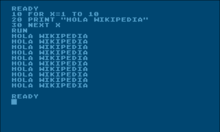
BASIC (Beginners' All-purpose Symbolic Instruction Code) is a family of general-purpose, high-level programming languages designed for ease of use. The original version was created by John G. Kemeny and Thomas E. Kurtz at Dartmouth College in 1964. They wanted to enable students in non-scientific fields to use computers. At the time, nearly all computers required writing custom software, which only scientists and mathematicians tended to learn.
In addition to the program language, Kemeny and Kurtz developed the Dartmouth Time Sharing System (DTSS), which allowed multiple users to edit and run BASIC programs simultaneously on remote terminals. This general model became very popular on minicomputer systems like the PDP-11 and Data General Nova in the late 1960s and early 1970s. Hewlett-Packard produced an entire computer line for this method of operation, introducing the HP2000 series in the late 1960s and continuing sales into the 1980s. Many early video games trace their history to one of these versions of BASIC.
The emergence of microcomputers in the mid-1970s led to the development of multiple BASIC dialects, including Microsoft BASIC in 1975. Due to the tiny main memory available on these machines, often 4 KB, a variety of Tiny BASIC dialects was also created. BASIC was available for almost any system of the era, and became the de facto programming language for home computer systems that emerged in the late 1970s. These PCs almost always had a BASIC interpreter installed by default, often in the machine's firmware or sometimes on a ROM cartridge. (Full article...)- In computing, a compiler is a computer program that translates computer code written in one programming language (the source language) into another language (the target language). The name "compiler" is primarily used for programs that translate source code from a high-level programming language to a lower level language (e.g. assembly language, object code, or machine code) to create an executable program.
There are many different types of compilers which produce output in different useful forms. A cross-compiler produces code for a different CPU or operating system than the one on which the cross-compiler itself runs. A bootstrap compiler is often a temporary compiler, used for compiling a more permanent or better optimised compiler for a language.
Related software include, a program that translates from a low-level language to a higher level one is a decompiler ; a program that translates between high-level languages, usually called a source-to-source compiler or transpiler. A language rewriter is usually a program that translates the form of expressions without a change of language. A compiler-compiler is a compiler that produces a compiler (or part of one), often in a generic and reusable way so as to be able to produce many differing compilers. (Full article...) 
Null or NULL is a special marker used in Structured Query Language to indicate that a data value does not exist in the database. Introduced by the creator of the relational database model, E. F. Codd, SQL Null serves to fulfil the requirement that all true relational database management systems (RDMS) support a representation of "missing information and inapplicable information". Codd also introduced the use of the lowercase Greek omega (ω) symbol to represent Null in database theory. In SQL,NULLis a reserved word used to identify this marker.
A null should not be confused with a value of 0. A null value indicates a lack of a value, which is not the same thing as a value of zero. For example, consider the question "How many books does Adam own?" The answer may be "zero" (we know that he owns none) or "null" (we do not know how many he owns). In a database table, the column reporting this answer would start out with no value (marked by Null), and it would not be updated with the value "zero" until we have ascertained that Adam owns no books.
SQL null is a state, not a value. This usage is quite different from most programming languages, where null value of a reference means it is not pointing to any object. (Full article...)- COBOL (/ˈkoʊbɒl, -bɔːl/; an acronym for "common business-oriented language") is a compiled English-like computer programming language designed for business use. It is an imperative, procedural and, since 2002, object-oriented language. COBOL is primarily used in business, finance, and administrative systems for companies and governments. COBOL is still widely used in applications deployed on mainframe computers, such as large-scale batch and transaction processing jobs. However, due to its declining popularity and the retirement of experienced COBOL programmers, programs are being migrated to new platforms, rewritten in modern languages or replaced with software packages. Most programming in COBOL is now purely to maintain existing applications; however, many large financial institutions were still developing new systems in COBOL as late as 2006.
COBOL was designed in 1959 by CODASYL and was partly based on the programming language FLOW-MATIC designed by Grace Hopper. It was created as part of a US Department of Defense effort to create a portable programming language for data processing. It was originally seen as a stopgap, but the Department of Defense promptly forced computer manufacturers to provide it, resulting in its widespread adoption. It was standardized in 1968 and has since been revised four times. Expansions include support for structured and object-oriented programming. The current standard is ISO/IEC 1989:2014.
COBOL statements have an English-like syntax, which was designed to be self-documenting and highly readable. However, it is verbose and uses over 300 reserved words. In contrast with modern, succinct syntax likey = x;, COBOL has a more English-like syntax (in this case,MOVE x TO y).
COBOL code is split into four divisions (identification, environment, data, and procedure) containing a rigid hierarchy of sections, paragraphs and sentences. Lacking a large standard library, the standard specifies 43 statements, 87 functions and just one class. (Full article...)  A program in paper tape
Information technology (IT) is the use of computers to create, process, store, retrieve, and exchange all kinds of electronic data and information. IT is typically used within the context of business operations as opposed to personal or entertainment technologies. IT is considered to be a subset of information and communications technology (ICT). An information technology system (IT system) is generally an information system, a communications system, or, more specifically speaking, a computer system — including all hardware, software, and peripheral equipment — operated by a limited group of IT users.
Humans have been storing, retrieving, manipulating, and communicating information since the Sumerians in Mesopotamia developed writing in about 3000 BC. However, the term information technology in its modern sense first appeared in a 1958 article published in the Harvard Business Review; authors Harold J. Leavitt and Thomas L. Whisler commented that "the new technology does not yet have a single established name. We shall call it information technology (IT)." Their definition consists of three categories: techniques for processing, the application of statistical and mathematical methods to decision-making, and the simulation of higher-order thinking through computer programs.
The term is commonly used as a synonym for computers and computer networks, but it also encompasses other information distribution technologies such as television and telephones. Several products or services within an economy are associated with information technology, including computer hardware, software, electronics, semiconductors, internet, telecom equipment, and e-commerce. (Full article...)
Fortran (/ˈfɔːrtræn/; formerly FORTRAN) is a general-purpose, compiled imperative programming language that is especially suited to numeric computation and scientific computing.
Fortran was originally developed by IBM in the 1950s for scientific and engineering applications, and subsequently came to dominate scientific computing. It has been in use for over six decades in computationally intensive areas such as numerical weather prediction, finite element analysis, computational fluid dynamics, geophysics, computational physics, crystallography and computational chemistry. It is a popular language for high-performance computing and is used for programs that benchmark and rank the world's fastest supercomputers.
Fortran has had numerous versions, each of which has added extensions while largely retaining compatibility with preceding versions. Successive versions have added support for structured programming
and processing of character-based data (FORTRAN 77), array programming, modular programming and generic programming (Fortran 90), high performance Fortran (Fortran 95), object-oriented programming (Fortran 2003), concurrent programming (Fortran 2008), and native parallel computing capabilities (Coarray Fortran 2008/2018). (Full article...)
MATLAB (an abbreviation of "MATrix LABoratory") is a proprietary multi-paradigm programming language and numeric computing environment developed by MathWorks. MATLAB allows matrix manipulations, plotting of functions and data, implementation of algorithms, creation of user interfaces, and interfacing with programs written in other languages.
Although MATLAB is intended primarily for numeric computing, an optional toolbox uses the MuPAD symbolic engine allowing access to symbolic computing abilities. An additional package, Simulink, adds graphical multi-domain simulation and model-based design for dynamic and embedded systems.
As of 2020, MATLAB has more than 4 million users worldwide. They come from various backgrounds of engineering, science, and economics. (Full article...)


.svg)


Selected images

GNOME Shell, GNOME Clocks, Evince, gThumb and GNOME Files at version 3.30, in a dark theme

An IBM Port-A-Punch punched card

Partial view of the Mandelbrot set. Step 1 of a zoom sequence: Gap between the "head" and the "body" also called the "seahorse valley".

Deep Blue was a chess-playing expert system run on a unique purpose-built IBM supercomputer. It was the first computer to win a game, and the first to win a match, against a reigning world champion under regular time controls. Photo taken at the Computer History Museum.
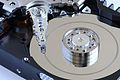
A head crash on a modern hard disk drive

A lone house. An image made using Blender 3D.

Grace Hopper at the UNIVAC keyboard, c. 1960. Grace Brewster Murray: American mathematician and rear admiral in the U.S. Navy who was a pioneer in developing computer technology, helping to devise UNIVAC I. the first commercial electronic computer, and naval applications for COBOL (common-business-oriented language).

Animation of a Non-uniform rational B-spline surface. Modeled and rendered in Cobalt.

This image (when viewed in full size, 1000 pixels wide) contains 1 million pixels, each of a different color.

Partial map of the Internet based on the January 15, 2005 data found on opte.org. Each line is drawn between two nodes, representing two IP addresses. The length of the lines are indicative of the delay between those two nodes. This graph represents less than 30% of the Class C networks reachable by the data collection program in early 2005.

A view of the GNU nano Text editor version 6.0

Stephen Wolfram is a British-American computer scientist, physicist, and businessman. He is known for his work in computer science, mathematics, and in theoretical physics.

Output from a (linearised) shallow water equation model of water in a bathtub. The water experiences 5 splashes which generate surface gravity waves that propagate away from the splash locations and reflect off of the bathtub walls.

Ada Lovelace was an English mathematician and writer, chiefly known for her work on Charles Babbage's proposed mechanical general-purpose computer, the Analytical Engine. She was the first to recognize that the machine had applications beyond pure calculation, and to have published the first algorithm intended to be carried out by such a machine. As a result, she is often regarded as the first computer programmer.

Bill Gosper's Glider Gun in action

Margaret Hamilton standing next to the navigation software that she and her MIT team produced for the Apollo Project.
_in_Dark_theme.png)


Did you know? -

- ... that Makoto Soejima is the only International Mathematical Olympiad gold medalist with a perfect score to have won both the Google Code Jam and the Facebook Hacker Cup?
- ... that David Ahl purchased BASIC-8 to sell with the PDP-8 when DEC management proved more interested in their own FOCAL language?
- ... that Earth 300 has designed a climate research vessel that would include a molten salt reactor and a quantum computer?
- ... that Jef Raskin would prove his FLOW language was easy to use by closing his eyes, typing randomly on the keyboard, and producing executable programs?
- ... that the main menu for the 2006 video game Curious George looked so simple that a reviewer thought he had an unfinished version of the game?
- ... that Guy Parmelin, now President of Switzerland, opened the study program of cyber security of the Lucerne School of Information Technology in 2018?
Subcategories

WikiProjects

- There are many users interested in computer programming, join them.
Computer programming news
No recent news
Topics


| Fields |  | ||||||
|---|---|---|---|---|---|---|---|
| Concepts |
| ||||||
| Orientations | |||||||
| Models |
| ||||||
| Related fields | |||||||
 Lists:
 Related portals


Associated Wikimedia


Portals